

The under-house cleanout, walked through
The space under a Gladesville brick house is the one part of the property you can't size up from the doorway, which makes this the job people are most wary of buying. So here it is in full: what's usually under there, how it comes out, and exactly how the fixed figure gets set before anyone crawls anywhere.
 Everything below is checkable. If the job we do doesn't match the job described here, say so.
Why this job gets bought blind
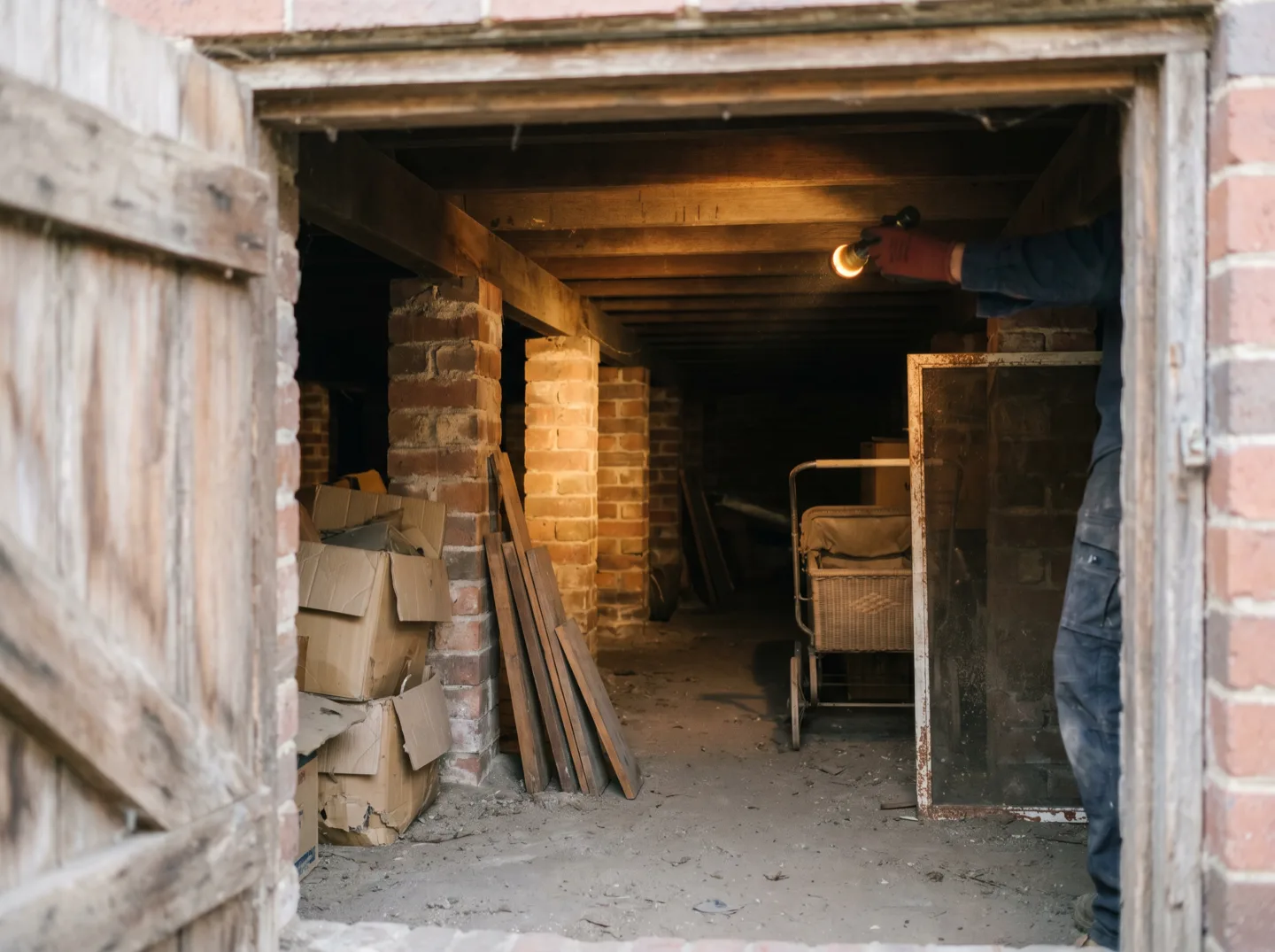
A garage you can stand in and count. The under-floor space you can't: it's dark, it's low, and the far end of it hasn't been visited since whoever put the last thing there backed out on their knees. Most people who ring us about it have never seen the whole space they're asking us to clear. That's normal, and it's also exactly the situation a bad operator can exploit, because a price you can't check against a space you can't see is barely a price at all.
The fix isn't bravery, it's paperwork. We look at the space with you, write one fixed figure for the whole job, and hand it over before a glove touches anything. This guide walks the entire job in advance so that when the figure lands on the sheet, you know precisely what it's buying: the space, the access, the sorting rules, the dust, and the finish.
What's under a ridge-street house, in section
The brick houses on Gladesville's high streets mostly date from the twenties through to the sixties, and they stand on brick piers rather than a slab. The floor above is level; the ground beneath is not. So the space under the house is a wedge: closer to standing height at the access door, shrinking to a flat crawl where the ground rises at the back.
The archaeology runs sideways
Under a house, age isn't stacked top to bottom the way it is in a garage. Things went in through the one door, nearest gap first, over decades. So the stuff by the door is recent, and the far wall is where the house keeps its earliest decisions. On a first look the torch tells us the front third; the quote allows honestly for the rest, and if the far corner holds more than the torch let on, the work pauses, you see it for yourself, and a new figure is agreed before another carton comes out. Never after.
A duck of the head
- The overflow of the last few years: whatever stopped fitting in the garage
- Paint tins and half-used garden chemicals, pushed in out of the weather
- The ladder, the fold-up table, the box of things meant for one more market day
A crouch, between piers
- The family layer: outgrown bikes, a cot, carpet offcuts from the last re-carpet
- Flywire doors and window screens that came off and never went back on
- Moving cartons from an address or two ago, tape gone brittle
A crawl, on boards
- Hardwood offcuts stacked by whoever built or extended the place
- The original casement windows or doors, swapped out decades back and kept
- The genuinely old things: trunks, a cane pram, and sometimes a sheet we treat as suspect until proven otherwise
How the figure is set by looking
There's no rate card for a space like this, and anyone who quotes one sight-unseen is guessing with your money. What there is instead is a short, learnable list of what the eye prices during the look. It takes us about ten minutes at your access door, and this is what's being weighed while we're down there with the torch:
| What the eye prices | What we're actually looking at | How it moves the figure |
|---|---|---|
| Volume, in carries | Not cubic metres: how many trips through that one low door the load will take. | More carries, bigger figure. The plainest lever of the four. |
| Access | Bearer height front to back, the distance from door to truck, whether the side path takes a wheelbarrow. | A crawl is slower than a crouch. Slow work costs more, and the figure says so up front instead of a meter saying it later. |
| Contents | Dense against bulky, and the split-offs: the fridge and e-waste that take a regulated route, the tins that take the chemical one. | Tip fees differ by stream. The figure carries each stream to its right destination, named on the sheet. |
| The finish | What "done" means here: carried clear and gone, or raked level and swept at the door as well. | Two different finishes, two different figures. You pick which one is being quoted before we start. |
Here's the part worth being blunt about. On an hourly rate, every unknown under your floor bills to you: the low bearer, the awkward corner, the carton that falls apart mid-carry. On a fixed figure agreed before the work, every one of those unknowns is our problem. That flips the incentive exactly the way you want it flipped: the crew that priced it by looking has every reason to look carefully, plan the carry chain properly and get it done well, because dawdling costs us, not you.
The figure holds still
The written quote covers the crawling, the carrying, the truck, the tip fees for every stream, and the agreed finish. It doesn't grow while your back is turned, and if the job genuinely turns out bigger than the look could show, the re-quote comes to you before the work continues, while no is still a real answer. The words on the sheet are all defined in the quote glossary if you want to check ours against anyone's.
The sheet, filled in for a typical ridge job
The shape of a real under-house cleanout, so you can see what a finished sheet says. It's an example, not your quote: the whole point of the model is that your figure gets set by looking at your space.
 Quote sheet · worked example
About a half truck, maybe a little more
Two of us, most of a day. One under the floor, one in the daylight, cartons moving between them; every ruling made by you, on the lawn, at your pace.
The fixed figure
Written here on the day, after the look, and agreed before a glove touches the pile. It's the one line this example can't fill in for you, because it's set by looking, not by guessing from a page.
How the day runs
The walkthrough proper. Every under-house cleanout we do follows this spine, and each step exists to keep the two things that matter intact: your say over every object, and a figure that was fixed before anything moved.
The look
Torch and quote pad at the access door, usually ten minutes or so. We check bearer heights, count the visible load, walk the path the cartons will travel, and ask what you already know is under there. You don't crawl anywhere, then or ever.
The figure, in writing
One fixed price for the whole job, handed to you on paper with what it covers named. Keep it, sleep on it, compare it. It holds, and nothing starts until you've agreed it.
The set-up
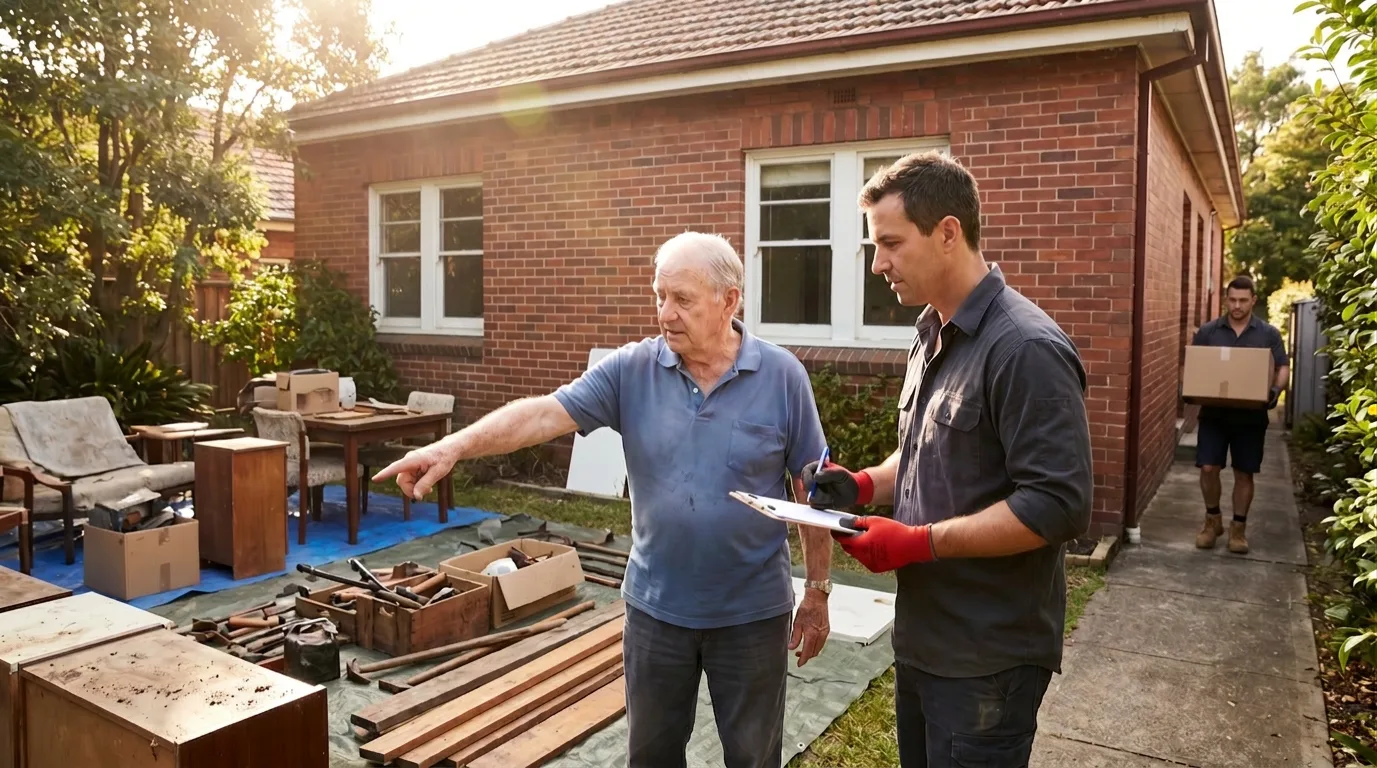
Boards go down where the ground is bare, torches and a lamp go in, and a staging area gets laid out in the daylight, usually the lawn or driveway, with drop sheets in rows: going, keeping, and show-me-first.
The carry-out
One of us under the floor, one in the light, everything passed out through the door one carry at a time. Anything that might matter, the tin with handwriting on it, the trunk, the box of papers, comes out unopened and goes straight to the show-me-first row.
The rulings, in daylight
You rule on the rows out on the lawn, in the light, at your pace, with the dust wiped off before you're asked to decide anything. Maybes get their own pile and one unhurried revisit at the end. A maybe never becomes a yes because the truck looks full.
The finish
The going pile loads onto the truck sorted by destination: general load, e-waste and whitegoods for the regulated route, anything chemical named for its own. Then the agreed finish happens, the rake and the sweep at the door, and the last thing we do is hand you the torch so you can see the space empty for yourself.
What stays under there
Not everything under the floor is load. Part of doing this job properly is knowing what doesn't move:
- The house's own workings. Plumbing runs, wiring, ductwork, and the ant caps on the piers are the house's business, not ours. We carry around them, never through them.
- Anything you're keeping. Keepers get carried out for their wipe-down and ruling like everything else, then stacked back under, up on timber and clear of the ground, or wherever else you'd rather they live.
- Anything we suspect is asbestos. Houses of this era sometimes keep leftover fibro under the floor. A suspect sheet stops the work on that spot: it stays exactly where it lies, you get a photograph, and that one corner becomes a job for a licensed asbestos removal contractor while we carry on with the rest. No junk truck can lawfully carry it, ours included; better said now than discovered later.
- Wildlife, briefly. Spiders we expect and dress for. A resident possum is protected and not ours to handle, so its corner waits until it has moved on, and we work the rest.
And a word on dust, because there's no honest version of this job without it. Decades of settled dust comes up with every carry. We keep it down and wipe things clear before you handle them, but the day goes better if the house is ready for it.
Before the crew arrives
- Leave the pile exactly where it is. The look prices what's there; moving it first earns nothing and costs you a weekend.
- Clear the side path and move the car off the driveway. That's the carry route and the staging ground.
- Close the windows on the access side and get the washing off the line. The dust is real.
- Pick your keep spot, so keepers have somewhere to land instead of wandering the lawn.
- Pets inside. An open access door is irresistible to exactly the wrong animals.
Nothing to prove before we look
You don't need to know what's under there. Most owners don't, and the guide you've just read is the crew's homework, not yours. The look costs nothing, and no is a complete answer to the figure.
The free option, measured against a crawl space
We point people at the free council pickup whenever it genuinely fits, so here's the honest measurement for this job. City of Ryde's pre-booked household cleanup collects from the kerb: nobody from the council goes under your house, so the crawling, carrying and hauling to the nature strip is yours before the truck ever arrives, and that carrying is precisely the hard part of this job. Each collection caps at 1.5 cubic metres with nothing over two metres long, an under-floor space of decades usually holds several collections' worth, bookings need about ten days' notice with five per property a year, and whatever the truck refuses is yours to carry back inside the boundary.
For a small planned pile you can carry out yourself, use the scheme and keep your money. For the whole space, priced in writing and carried by people with knee pads, that's us. If your street falls on the Hunters Hill side of the boundary, check that council's scheme directly before counting on it. The full comparison is written down.
Asked about the crawl
Can't it all just stay under there?
Honestly, yes, and for years it probably has. The space calls time on itself when something changes: a sale is the big one, because a pre-purchase building and pest inspection wants to get under the floor, and a packed subfloor tends to get written up as restricted access, which is not a sentence you want a buyer reading. Restumping, pest treatment and underfloor insulation all want the space clear too. If none of that's on the horizon, there's no rush, and we'd tell you so at the look.
Will the council cleanup take what's under the house?
Only from the kerb. The council crew doesn't come onto the property, so everything would need carrying out and up to the nature strip first, within the volume cap and the two-metre length limit, with a booking made about ten days ahead. Getting it out from under the floor is the actual job, which is why the free option so rarely rescues this one. The full comparison covers it properly.
What about spiders, and worse?
Spiders are a certainty and we dress for them: gloves, sleeves, torches, and a healthy respect for the dark side of every carton. Anything living beyond that gets dealt with honestly rather than heroically. A resident possum is protected, so its corner of the space waits until it has moved on, and we clear everything else meanwhile.
Do you need power or lighting under there?
No. Torches, a battery lamp and boards all come with us, and nothing needs plugging in. If the space has no working light it's no different from most of the spaces we clear.
Is there an under-floor space you'd turn down?
A few, and we'll say so at the look rather than discover it on your bill. If the clearance at the back is too tight to pass a carton through safely, or the ground under there is waterlogged, we quote what can be done properly, name what can't, and if waiting for a dry week is the right call, that's the advice. A written figure is only worth something if the job behind it is doable.
A straight answer costs nothing
Tell us what needs to go and where it is. We come back with a plan and a fixed price, in writing, and nothing gets lifted until you have agreed it.
Your enquiry goes straight to the crew, and we ring you back on the number you leave.