

Furniture & reno debris removal in Gladesville
The tiler's gone, the new kitchen is in, and what's left is the old one: carcasses on the lawn, rubble in bags, a benchtop nobody can lift alone, and the sofa the new layout retired. We load the lot in one visit, with the price in writing before we start.
 No skip, no permit, no fortnight of a bin out the front. The truck comes once.
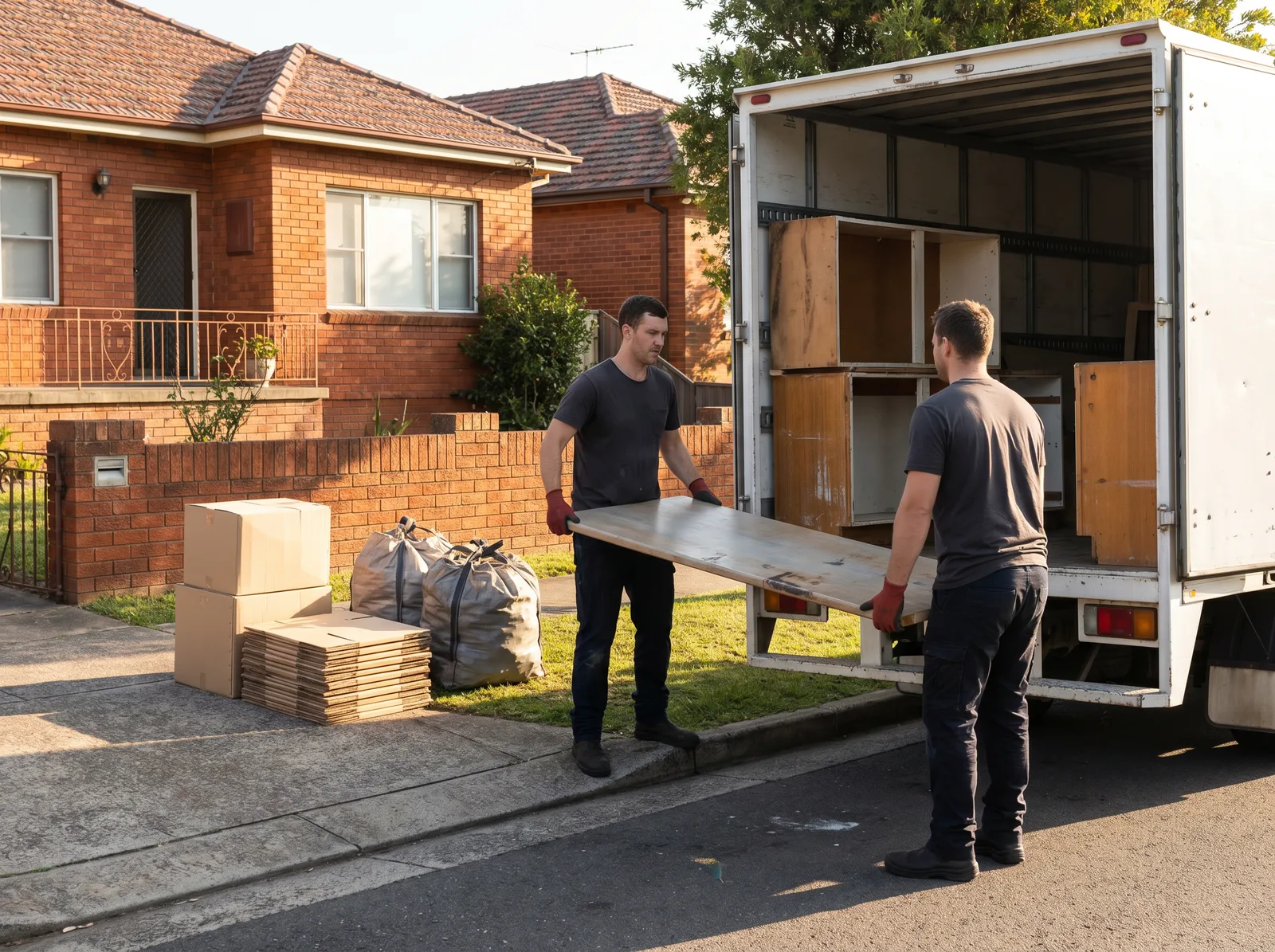
The pile the reno leaves behind
Renovators find this out the same way every time: the quote covered the new bathroom, not the old one. The strip-out lands on the lawn or the balcony, the trades finish and drive off, and the pile is suddenly yours. Meanwhile the carpet layer is booked for Thursday and the building manager has already sent one email about the bags near the lift.
Most of what we clear off the back of a reno is the same short list: the old kitchen in carcass form, a vanity and a shower screen, tile and render rubble in bags, plasterboard offcuts, timber with the nails still in it, and a drop sheet's worth of oddments. Single-room refits and unit bathrooms make up the bulk of it. That work doesn't need a demolition contractor. It needs a crew with a truck, gloves and a written figure.
And the furniture the new layout retired
Half the time the reno evicts furniture too: the lounge that doesn't fit the new open plan, the wardrobe the built-ins replaced, the eight-seater that made sense in the old dining room. It rides on the same truck as the debris, inside the same written figure. If it's furniture on its own, no rubble attached, that's an everyday pickup and we do those all week.
No skip on the street, because there's nowhere to put one
Around here the skip maths rarely works. In the buildings along Victoria Road and Wharf Road, strata won't wear a bin on common property, the visitor parks are spoken for, and the dock is booked in windows, not weeks. On the ridge streets the kerb is parked out early, a bin on the road reserve needs the council's permission, and a driveway bin blocks the driveway for a fortnight while the neighbourhood quietly helps you fill it.
Our version is simpler: the truck is the skip, and it's only here for the loading.
- The building handled. Lift booking, dock window and the manager's conditions arranged by us before the truck leaves Gladesville.
- The carrying done. Rubble moves in manageable bag loads on trolleys, floor protection goes down through the common areas, and benchtops get walked out flat.
- One visit, not a fortnight. Loaded and swept the same day the truck arrives. Nothing sits out the front collecting rain and by-law letters.
- Timed around Victoria Road. We run on and off the peninsula outside the peak, so the dock window you booked and the truck's arrival actually agree.

Tiles weigh what they weigh
Most rubbish is priced by how much room it takes on the truck. Reno debris is the exception: the tip weighs the truck in and out, and dense material moves the figure by weight, not by the cubic metre. A load of tile rubble can weigh ten times what the same volume of furniture does, and someone should be straight with you about that before it's on the truck.
So it goes on the sheet up front. When your photos show rubble, brick or wet-area render, the written quote names the dense material and prices it in from the start. What we never do is load first and let the weight surface on an invoice afterwards. And if the pile turns out heavier than the photos let on, we re-quote before it's loaded, while no is still a real answer.
| Material | How it loads | What moves the figure |
|---|---|---|
| Tile, brick and render rubble | Dense. A dozen bags is a serious weight long before it's a serious volume. | Weight, named on the sheet up front |
| Plasterboard offcuts | Light but bulky, and it travels its own route at the facility. | Volume |
| Kitchen carcasses and benchtops | Awkward more than heavy. Benchtops walk out flat, carcasses stack. | Volume, plus the carry |
| Vanities, baths and shower screens | Glass and sharp edges, wrapped and handled properly. | The carry, not the weight |
| Retired furniture | Bulky and light. The easy end of the load. | Volume |
When a skip, or the council, is honestly the better call
A skip earns its keep on one kind of job: a strip-out you're doing yourself over weeks, filling as you go, with a driveway you can spare. If that's your reno, hire the bin and don't let anyone talk you out of it. Our job is the other kind: one pile, one deadline, nowhere to put a bin and nobody spare to fill it.
The free option gets the same straight answer. City of Ryde's household cleanup is a genuinely good scheme and we point people at it every week, but it's a household-items service on a booked date around ten days out, capped at 1.5 cubic metres a collection. Renovation rubble isn't the job it exists for, and a reno deadline rarely survives the wait.
How the clearout runs
Send photos of the pile
The form takes them. Show the bags, the benchtop, whatever's under the tarp, and name the deadline that matters: the carpet layer's Thursday, the building's dock window, the open home.
The figure arrives in writing
One fixed price for the whole pile, with the dense material named, tip fees inside it and any building arrangements inside it. You agree it before anything is lifted.
Loading day
We bring the trolleys, the bags and the floor protection. You point, we carry. Units run through the lift and dock the building agreed to, houses run down the side path, and the space gets swept before the truck door closes.
Sorted where it goes
Metal, timber, clean rubble and general waste each leave the truck by their own route, at facilities licensed to take them. Not glamorous, just done properly, and inside the figure you already agreed.
Asked mid-reno
The straight no: asbestos
A lot of the ridge's housing stock went up when fibro was standard kit, and renovations are where it surfaces: sheeting behind wall tiles, under lino, in eaves and bathroom walls. We don't take asbestos, and no rubbish crew legally should. If the strip-out has exposed sheeting nobody can vouch for, stop, leave it undisturbed, and get a licensed asbestos assessor onto it first. We'll gladly clear everything else once it's been dealt with.
Can you get tile rubble out of a third-floor unit?
Yes, and it's half our reno work. Rubble travels in manageable bag loads on trolleys, the lift gets booked and padded, floor protection goes down through the common areas, and the dock window is arranged with your building manager before the truck leaves Gladesville. The strata rules are our problem on the day, not yours.
The tiler said he'd take the rubble. He didn't. How fast can you come?
Send photos as soon as the pile is yours and tell us which trade is booked next. We book against that date, not a vague window. Same-day where the run allows, and a straight answer about what's possible either way.
Why does a small pile of rubble cost more than a big pile of furniture?
Because the tip weighs us in and out. Furniture is volume; rubble is weight, and the scale doesn't care how tidy the bags look. That's exactly why dense material is named on your written quote before we lift it, instead of turning up as a surprise line afterwards.
Do I need to bag or move anything before you arrive?
No. If the tiler already bagged the rubble, good, it moves in safe trolley loads. But loading is our job: where the truck backs up close, loose is fine, and we bring heavy-duty bags for anything that needs them.
What about leftover paint and chemicals?
Tins with wet paint, solvents and pool chemicals can't ride the truck; household chemicals have their own disposal routes and we'll point you at the right one. Fully dried-out tins and empties are fine on the load.
A straight answer costs nothing
Tell us what needs to go and where it is. We come back with a plan and a fixed price, in writing, and nothing gets lifted until you have agreed it.
Your enquiry goes straight to the crew, and we ring you back on the number you leave.